Curriculum
We are currently in the process of updating our website and this page will change frequently.
In the meantime, should you struggle to find the information you require, please contact the school office for assistance.
Our Curriculum
This page is structured to outline our intents and the ways we implement our curriculum here at Leamore.
However, in the interests of helping children and parents find the half-termly plans, we have put Year Group specific half-termly plans at the top of this page.
To find out more about the progression documents and Long Term Plans (LTPs), please continue scrolling.
Intent
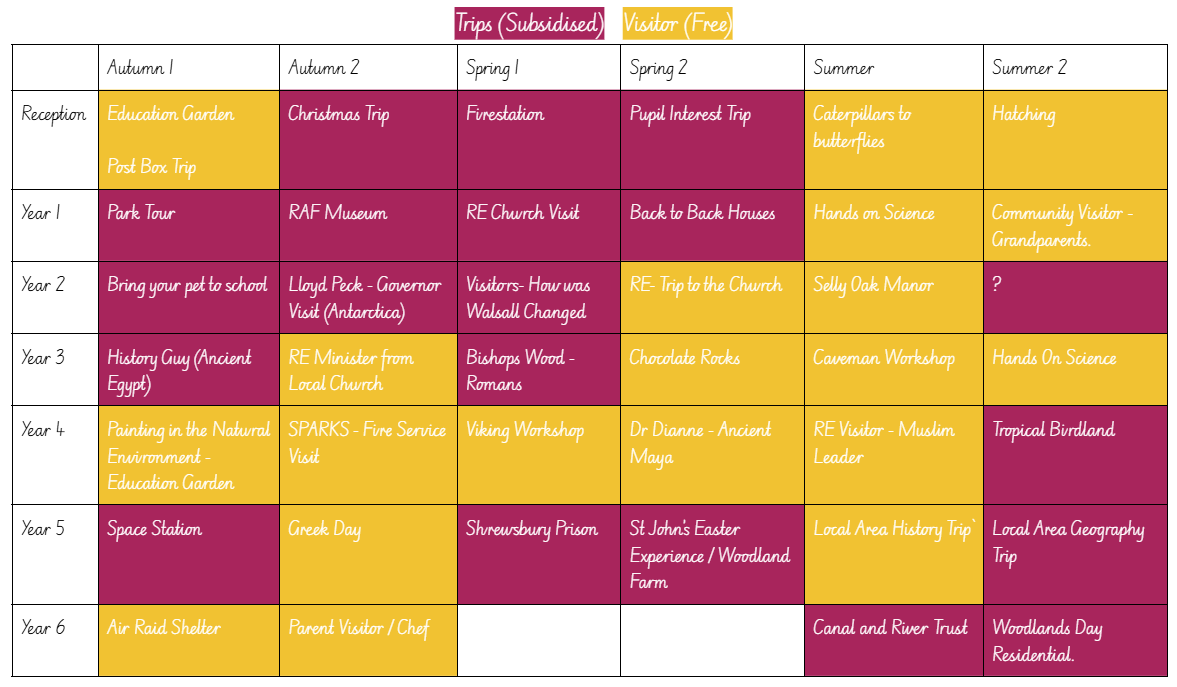
Our curriculum is based on the National Curriculum but focuses on teaching children the knowledge and skills they need to learn more and remember more. Our pupils are offered a full, un-narrowed curriculum with a wide range of experiences to extend their understanding of themselves and the world in which they live - developing skills, attitudes and values that prepare them for the next stage of learning (Key Stage 1, Key Stage 2 or transition to Secondary) and enabling them to be successful in the community. It is also our intent to help build the cultural capital of our pupils by providing enrichment experiences through educational visits or through workshops and bringing experts into school.
Implementation
We believe that effective learning takes place when there is considerable emphasis on active involvement - where pupils work both imaginatively and expressively and have opportunities to explain and clarify thinking. We make meaningful connections across subjects and sequence learning to ensure that pupils build on prior learning to enable them to make progress from their individual starting points.
At Leamore, we expect everyone to develop and show a sense of responsibility and self-discipline whether alone, together, at work or at play, and support policies on equal opportunities. We actively promote British values of democracy, the rule of law, individual liberty, and mutual respect and the inclusion of those with different faiths and beliefs to prepare our pupils for life in modern day Britain. We also provide opportunities for our pupils to learn about the contribution of Britons to innovation, excellence and changes in the world.
Impact
Our carefully-designed approach allows our leaders to effectively measure the impact that their subject is having in terms of pupil voice, assessment data and staff voice. These holistics inform subject action plans that in turn inform the Curriculum Action Plan to ensure that Leamore provides an ever-improving offer for its pupils and for the whole school community.
Aims
- That all pupils are provided with outstanding learning experiences that lead to consistently outstanding levels of pupil achievement.
- From the start, children are taught in differentiated groups to allow further consolidation for some, and for greater speed and breadth of delivery at the upper end of attainment.
- That all teachers and other professionals possess expert levels of knowledge in the subjects they teach.
- That all teachers and other professionals are “life-long learners”, committed to an ongoing development of their own knowledge and skills to optimise the pupils’ learning experiences.
- That a positive, caring attitude, where achievements at all levels are acknowledged and valued, is prevalent throughout the school.
- That all pupils from the earliest opportunity, are encouraged to develop independence, self-discipline, responsibility and the ability to build resilience.
Subject Long-term Plans (LTPs) and Policies
Writing
CLPE’s ‘The Power of Reading’ offers a curriculum based on high-quality children's books. The scheme fosters reading and writing for pleasure and raises achievement in literacy through fun, varied learning.
Each year, the programme is evaluated and developed to include the latest research and new texts and approaches to ensure schools:
- Develop an inclusive and progressive curriculum for English across school;
- Enhance subject knowledge of reading and writing across the primary years;
- Use quality texts to plan comprehensive and engaging English lessons, with context-embedded opportunities to use and apply phonics, spelling and grammar;
- Provide strategies and approaches to increase children's engagement and attainment in reading and writing;
- Develop a culture of reading and writing for pleasure.
However, if you require more detailed information, please click the link below to go to the National Curriculum which outlines what schools MUST teach:
National Curriculum
Reading and Phonics
Here at Leamore, we feel being able to read is paramount. Not only does it allow our children to learn independently, it provides a doorway into unknown realms, the ability to experience situations and scenarios they may never come across in their own lives and provides exposure to new, exciting vocabulary and language structures.
Phonics
At Leamore Primary School, we believe that all our children can become fluent readers and writers. This is why we teach reading through Little Wandle Letters and Sounds Revised, which is a systematic and synthetic phonics programme. We start teaching phonics in Nursery/Reception and follow the Little Wandle Letters and Sounds Revised progression, which ensures children build on their growing knowledge of the alphabetic code, mastering phonics to read and spell as they move through school.
As a result, all our children are able to tackle any unfamiliar words as they read. At Leamore Primary School, we also model the application of the alphabetic code through phonics in shared reading and writing, both inside and outside of the phonics lesson and across the curriculum. We have a strong focus on language development for our children because we know that speaking and listening are crucial skills for reading and writing in all subjects.
Reading
To help children get the most from reading, our school uses the Big Reading scheme.
This scheme uses mini missions and a Big Reading session to help teach all of the skills involved in reading.
The scheme also introduces the key skills through using fun, relatable characters such as Rex Retriever, Expi Explorer, Ansa Analyser, Dood Detective.
In addition to this, so that our children get opportunities to use their phonics learning to build reading skills, we use the Oxford Reading Tree and Big Cat reading books to support reading and phonics progression.
Maths
Mastery in Mathematics at Leamore Primary School 2025/26
All pupils are encouraged by the belief that by working hard at maths they can succeed.
- Pupils are taught through whole-class interactive teaching, where the focus is on all pupils working together on the same lesson content at the same time. This ensures that all can master concepts before moving to the next part of the curriculum sequence, allowing no pupil to be left behind.
- If a pupil fails to grasp a concept or procedure, this is identified quickly and early intervention ensures the pupil is ready to move forward with the whole class in the next lesson.
- Should a child, or a group of children, be significantly lower than the class’ curriculum, they will be working on fluency tasks in order to understand the process of the concept, sometimes named ‘side tasks’.
- Lesson design identifies the new mathematics that is to be taught, the key points, the difficult points and a carefully sequenced journey through the learning. In a typical lesson the teacher leads back and forth interaction, including questioning, short tasks, explanation, demonstration, and discussion.
- When children have mastered a concept in maths, these may need to use staggered starts, missing the first fluency questions and moving on to the reasoning and problem solving parts of the work straight away. This ensures that these children do not lose time on something they have already demonstrated that they can do.
- Procedural fluency and conceptual understanding are developed in tandem because each supports the development of the other.
- It is recognised that practice is a vital part of learning, but the practice used is intelligent practice that both reinforces pupils’ procedural fluency and develops their conceptual understanding.
- Significant time is spent developing deep knowledge of the key ideas that are needed to underpin future learning. The structure and connections within the mathematics are emphasised, so that pupils develop deep learning that can be sustained.
- Key facts such as multiplication tables and addition facts within 10 are learnt to automaticity to avoid cognitive overload in the working memory and enable pupils to focus on new concepts.
Mastery Approach at Leamore Primary
Since September 2022, we have begun to introduce a mastery approach to our teaching and learning in mathematics at Leamore Primary School. The mastery-learning model means spending greater time going into depth when learning a concept or procedure and not racing through the curriculum.
Rushing through content can lead to some children having large gaps in subject knowledge because the concept they had just learnt was either too big or learnt too quickly. A mastery approach means that we are taking learning at a steadier and deeper pace, trying to ensure that children are not left behind; as well as providing deeper and richer experiences for children who are above the national expectation for their age. We are focussing on all children achieving what is expected of their age group and not going beyond this.
Evidence shows that children need to be taught a concept, learn to apply it in a range of situations and then be creative with it, in order to really understand it. Simply going beyond their age group does not guarantee they understand something, it just means they can apply a method/algorithm correctly. Our children are being taught content from the year group they are in, they are spending time becoming true masters of the relevant content, applying it and embedding their new knowledge and skills in multiple ways.
We are developing this approach through the Power Maths resources. Lessons follow a particular format, which include the following elements:
Yesterday, last week, last month: This is our starter and our teachers provide questions from these times, so children can keep using what they have learned over time and keep the knowledge fresh for whenever the concept comes up in another part of the maths curriculum.
Discover: Every lesson starts with a Discover task to get children to solve a problem that aims to generate curiosity. During the Discover section, children may use manipulatives to help them understand the maths and explain their method.
Share: The next stage encourages children to Share the methods they have tried to solve the problem in Discover.
Think Together: We only learn when we are thinking! In this section Power Maths takes the approach “I do, we do, you do”, as children apply the knowledge they have just learned in a series of problems that continue to encourage thinking throughout.
Practice: Children are then ready for some independent Practice.
Reflect: The final Reflect question helps the children evaluate whether they have understood the key concept and small steps that they have been trying to master in the lesson.
Art & Design
At Leamore Primary School, our intent is to consistently develop Imagination and challenge the creative skills and knowledge year on year. Children have opportunities to take their experiences of the world and transform them through drawing, painting, textiles and 3D sculptures. This helps to prepare them for all of the different artistic areas they will be exposed to after life at Leamore.
Our goals are:
- to ensure that all our children develop the necessary skills in Art & Design that will enable them to consider health and safety aspects to ensure they are safe whilst working with tools and equipment
- to give pupils opportunities to design, make and evaluate purposeful, functional and innovative products that are both appealing and functional when necessary.
- to allow pupils to explore and develop an enjoyment of working with a range of materials and mediums.
- Supporting our children to explore what an artist is and how using a range of skills and mediums support artistic expression.
- Giving our children the opportunity to be inspired by a range of artists and designers.
Our delivery of the Art & Design curriculum does not follow a commercially available scheme. Instead, we have developed a home-grown knowledge and skills based curriculum with progress linked Long Term and Medium Term plans. (see below). We have decided to use this as our base because it allows us to make art bespoke for our pupils - building their cultural capital and consistently developing and broadening their awareness of what an artist is.
An example of how this materialises can be seen when children in Year 1 begin learning and using their skills within painting. These children start looking at primary colours and how these can mix. This knowledge is then transferred into Years 2 to 4. The children need to have the experiences in Year 1 to help broaden their understanding of primary colours to then look at secondary and tertiary colours before beginning to look at the colour choices of specific artists such as Georges Seurat when using his style to build pictures from individual coloured dots. Additionally, children are encouraged to relate this developing understanding to explore how changes in colour helps artists convey mood and feeling.
Citizenship (P.S.H.E) & R.S.E
We believe that children are individuals and therefore, we aim to encourage mutual respect, responsibility and build self-esteem in a caring and supportive environment. Our curriculum allows students to develop an understanding of the world around them and gain the skills necessary to live healthy, safe, fulfilling, responsible and balanced lives through the use of the Jigsaw scheme of work.
The Jigsaw Programme offers us a comprehensive, carefully thought-through scheme of work which brings consistency and progression to our children’s learning in this vital curriculum area. The scheme promotes the spiritual, moral, cultural, mental and physical development of pupils at the school and of society, and prepares pupils for the opportunities, responsibilities and experiences of later life.
Pupils from Year Groups 1 to 6 learn skills through 6 puzzle pieces, with each piece covered termly:
Being me in my world
Celebrating Difference
Dreams and Goals
Healthy Me
Relationships
Changing Me
The skills and knowledge in these pieces are developed through each year group, with pupils building upon prior learning. For example, in Year 1, as part of the Celebrating Difference puzzle piece, pupils learn about bullying. In the year groups that follow, pupils knowledge and understanding is developed further as they learn about different types of bullying and ways in which bullying can be dealt with. In addition, the Jigsaw scheme of work is compliant with the DfE regulations (2019) for statutory Relationships and Health Education. This is taught as part of the Relationships and Changing Me puzzle pieces.
Computing
At Leamore Primary School, our intent is to deliver a high-quality computing curriculum that equips pupils with the knowledge, skills and understanding to thrive in an increasingly digital world. Using the updated Purple Mash scheme of work, we aim to ensure all children become confident, responsible and creative users of technology.
Our curriculum is designed to be ambitious, inclusive and progressive, enabling pupils to develop their understanding of the three core strands of computing: computer science, information technology and digital literacy. Through carefully sequenced learning in Purple Mash, pupils revisit and build upon key concepts such as coding, data handling, digital creativity and online safety, ensuring secure progression from Y1 through to Year 6.
We intend for pupils to:
- Develop strong computational thinking skills, including problem-solving, logical reasoning and creativity
- Gain hands-on experience with coding and programming, using age-appropriate tools and real-world contexts
- Become digitally literate, able to create, evaluate and refine digital content for a range of purposes
- Understand how to use technology safely, respectfully and responsibly, including knowing how to seek help and manage risks online
- Build confidence and independence when using technology to support learning across the wider curriculum
The Purple Mash scheme supports high levels of engagement through interactive, creative and cross-curricular activities, while also providing opportunities for assessment and retrieval to strengthen long-term learning. Our intent is that by the time pupils leave Leamore Primary School, they are well-prepared for the next stage of their education and able to participate positively and safely in the digital world.
Design & Technology
At Leamore, the intent of our Design and Technology curriculum is to deliver a high-quality, progressive programme of learning that enables all pupils, regardless of starting point, to access, achieve and develop essential knowledge, understanding and skills year on year. We are committed to ensuring that every child builds the confidence, resilience and technical competence required to design, make and evaluate purposeful, functional and innovative products. Central to this is the development of a strong understanding of health and safety principles, ensuring that pupils are able to work safely and responsibly with a range of tools, materials and equipment.
Leamore’s Design and Technology curriculum is carefully structured and coherently sequenced using guidance and high-quality resources from the Design and Technology Association, including the recommended curriculum planning framework Projects on a Page. Our curriculum ensures clear progression in knowledge, technical understanding and practical skills across all year groups. Each project is designed to build systematically on prior learning, enabling pupils to revisit, deepen and apply key concepts in increasingly complex contexts. This approach secures thorough, embedded knowledge and supports the consistent development of designing, making and evaluating skills across all areas of Design and Technology, including mechanisms, structures, textiles, electrical systems and food technology. Through this carefully mapped progression, pupils gain both the disciplinary knowledge and practical competence necessary to achieve high standards and develop as confident, capable designers and makers.
French
At Leamore Primary School, we believe that learning a foreign language is essential in fostering a global mindset and cultural understanding among our students. Our MFL curriculum, focused on the French language, is implemented in KS2 and designed to inspire curiosity, develop communication skills, and promote cultural awareness.
Through the CGP Salut! scheme, lessons are structured to build both linguistic knowledge and disciplinary knowledge. Pupils learn not only vocabulary and phrases but also how the French language works—its phonics, grammar patterns, and sentence structures—so they can apply this understanding independently in speaking, listening, reading, and writing. Lessons are interactive and engaging, incorporating games, songs, and stories to reinforce knowledge and ensure active participation. Termly assessments track progress and allow teaching to be adapted to meet the diverse needs of our learners.
By the end of their time at Leamore Primary School, pupils will have a secure foundation in the French language, an understanding of French culture, and the confidence to communicate effectively. They will leave with a love of languages, a growing awareness of how language systems work, and the skills to apply their learning in new contexts.
In conclusion, the MFL curriculum at Leamore Primary School is designed to equip pupils with both substantive knowledge (vocabulary, culture, phrases) and disciplinary knowledge (how the language works, application across skills), nurturing confident, culturally aware, and empathetic learners ready to engage with an increasingly interconnected world.
Geography
We teach children that Geography is more than just a study of the world's maps, how it was, how it is and how it will be, but we also encourage a curiosity about places near or far. At Leamore, we wish to give children an insight into how the world works and the problems it faces now and in the future. In addition to studying their own locality, children will be given opportunities to study landscapes and places that they do not ordinarily have the chance to experience. Children are given the chance to question why the world is the way it is and to use each other, staff and resources to get a response to these questions in order to push their learning on.
History
We are committed to providing children with a range of learning opportunities to engage with the past. Our teaching of History aims to help children develop a chronological framework for their knowledge of significant events and people, both in Britain and the wider World. Through this, children develop a sense of identity and an awareness of the challenges of their time. The teaching of History at Leamore aims to help pupils understand the process of change, the diversity of societies and the relationship between different groups in their own local area and those unfamiliar to them. The teaching of historical enquiry allows children to develop the expertise required to interpret and evaluate evidence, ask questions, think critically and argue for their point of view- skills highly valuable in adult life.
History Useful Links
- World and British History for Kids - Woodlands Resources
- KS2 History - BBC Bitesize
- Historical Association
- Welcome to the Homework Gnome! | TheSchoolRun
Fun History Activities and Quizzes
- Horrible Histories: Awesome Women - CBBC - BBC
- Ancient Greece - Daily Life - Typical House - The British Museum
- Raid and Trade - Free Primary KS2 History Game - Learn about Vikings - BBC Bitesize
- KS2 History game - Learn about ancient Greece and the Olympic games for Primary school children - Ancient Greeks: The Argo Odyssey - BBC Bitesize
Music
At Leamore Primary School, our intent is to deliver a high-quality music education that inspires creativity, self-expression and a lifelong appreciation of music. Through the Charanga Creative Music Scheme, we provide an inclusive, progressive and engaging curriculum that enables all pupils to develop musical knowledge, skills and understanding, regardless of prior experience.
Our music curriculum is carefully sequenced to ensure progression in the key strands of performing, composing, listening and appraising. Using Charanga’s Creative Music Scheme, pupils explore a wide range of musical styles, genres and traditions, building a secure understanding of musical elements such as rhythm, pitch, tempo, dynamics, structure and texture. Learning is practical and exploratory, allowing pupils to develop confidence through singing, playing instruments, improvising and composing.
We intend for pupils to:
-
Develop a strong musical vocabulary and understanding of how music is created, performed and evaluated
-
Perform with increasing confidence, control and expression, both individually and collaboratively
-
Compose and improvise using a range of musical elements and technologies
-
Listen critically and respond thoughtfully to music from a variety of cultures, traditions and historical periods
-
Build resilience, creativity and teamwork through regular musical experiences
The Creative Music Scheme supports inclusive practice by offering accessible entry points for all learners, while also providing opportunities for challenge and enrichment. Cross-curricular links, performance opportunities and digital tools enhance engagement and ensure music is valued as an integral part of school life.
By the time pupils leave Leamore Primary School, our intent is that they have developed a secure musical foundation, a positive musical identity and the confidence to participate in and enjoy music beyond the classroom.
Physical Education
At Leamore Primary School, Physical Education is about far more than learning sports skills; it is about developing the whole child. Our iMoves approach underpins a high-quality PE curriculum that inspires all pupils to succeed and excel physically through the development of movement, strength, coordination and healthy competition. We provide opportunities for pupils to become physically confident in ways that support their overall health and fitness, while also encouraging participation in competitive sports and activities that build character and promote values such as fairness and respect.
Our PE programme is rooted in a strong foundation of fundamental movement skills and ensures that every child has the opportunity not only to take part, but to know more, do more and excel. All learning takes place in a fun, engaging and supportive environment where pupils feel motivated and challenged.
It is our intent that all children at Leamore Primary School experience a consistently high standard of Physical Education. Through PE, pupils learn to cooperate and collaborate as part of a team, developing an understanding of equality, fair play and respect that supports lifelong learning. Children are encouraged to thrive in a safe, stimulating and active environment that nurtures confidence, resilience and enjoyment of physical activity.
Children also have the opportunity to participate in swimming.

Religious Education
Through good quality Religious Education (RE), our children will leave Leamore with an in-depth knowledge and understanding of the religions and beliefs, which form part of our contemporary society. Our RE lessons will consistently motivate and inspire children to explore religious viewpoints and be open-minded and tolerant to the beliefs of others.
Intent
At Leamore Primary School, we use the Walsall SACRE Scheme of work. We use this scheme because RE, unlike other areas of the curriculum, is a local responsibility. Through the SACRE, our local community has the opportunity to influence directly what pupils learn in RE. The Syllabus aims to promote understanding between all people and prepares the children and young people of Walsall for active citizenship in a diverse and rapidly changing world. The scheme provides clear development of religious topics that are explored right from the younger years to our Year 6 class. For example year one is an introduction to learning about Sikh people, symbols and stories and this is developed and carried right through school until Year 6 when they compare key figures of inspiration in the Sikh community and compare these to other religions.
Through this curriculum, we aim to equip our children with the skills they need to be respectful towards others and have an awareness of the cultural diversity within our world. We teach them about a wide range of religions and compare and contrast these faiths. Children are given opportunities to learn about religions whilst being encouraged to be respectful and a good citizen within our community.
How we teach Religious Education at our school
Religious Education at our school follows the Agreed Syllabus set by Walsall SACRE. Our RE curriculum is carefully designed to develop pupils’ knowledge about religions and worldviews as well as their ability to think carefully and critically about belief.
Why Religious Education matters
Religious Education helps pupils to understand the world around them and their place within it. By combining strong knowledge of religions with critical thinking skills, our RE curriculum supports pupils’ spiritual, moral, social, and cultural development.
Our approach to Religious Education
We aim to ensure that pupils:
- Develop respect and understanding for people of all faiths and none
- Learn to express their own ideas clearly and thoughtfully
- Build skills in reasoning, discussion, and reflection
- Are well prepared for life in a diverse society
In line with the Walsall Agreed Syllabus, our RE curriculum develops secure substantive knowledge of religions and worldviews, alongside disciplinary knowledge that enables pupils to interpret, analyse, evaluate and reflect on religious belief and practice. This ensures pupils not only know about religions, but understand their significance and can engage critically and respectfully with them.
Walsall SACRE encourages pupils to engage in:
- Theological thinking (beliefs about God, salvation, authority)
- Philosophical thinking (meaning, truth, morality)
- Social-scientific thinking (community, identity, diversity
What pupils learn in Religious Education
In RE, pupils build secure knowledge of a range of religions and worldviews. This includes:
- Core beliefs about God, life, and meaning
- Religious practices such as prayer, worship, and festivals
- Sacred texts and key stories
- How faith is lived out by individuals and communities today
Pupils revisit key ideas as they move through the school, developing deeper understanding and more complex ideas over time.
How pupils learn in Religious Education
RE lessons are taught through enquiry-based questions that encourage pupils to think, discuss, and reflect. Pupils are taught to:
- Ask thoughtful questions about belief and meaning
- Explore different interpretations of religious texts and ideas
- Compare similarities and differences between religions and worldviews
- Use evidence and examples to explain their thinking
- Reflect on how beliefs influence people’s lives
This approach helps pupils learn how to study religion, not just facts about it.
Science Curriculum
At Leamore, it is our intent for pupil to learn Science through experimentation, practice and discussion so children gain core knowledge around:
- Scientific vocabulary
- ‘Working scientifically’ skills including systematic and careful observations and following practical scientific methods
- The gathering and interpretation of straightforward scientific evidence
- The use of everyday materials and scientific equipment to solve science problems
- Articulating scientific concepts and using five types of science enquiries
We believe that children should be taught science in a way that helps nurture an understanding of the value of scientific skills. But, we also think science learning should be engaging and inspiring.
We follow the White Rose Science scheme of work for our curriculum for Science. The White Rose Science approach provides our pupils with much needed opportunities to develop oracy and articulation when talking about concepts and allows them to internalise what they are learning more robustly. White Rose have stated their scheme helps to deliver, 'Science, in a fun and logical way' and we agree that this is the case.
In addition, it provides teachers with all the guidance and supporting materials they need to plan and deliver a high quality science education. The schemes of learning provide full coverage of the national curriculum knowledge elements for science but they don’t stop there. They also cover scientific questions around sustainability and the planet, and help children develop empathy for the local and wider environment.
The key to the success of White Rose Science is a small step approach - something that our pupils have shown they work well with across many monitoring sessions in school. White Rose breaks down the essential aspects of key stage science into easily digestible chunks across age-appropriate units.
The Long-term plan has been included below.